
Introduction
Quietly devastating to your productivity is losing track of invoices, expenses, payments and client records. This is why this FreshBooks review 2026 is important to freelancers, consultants, contractors, agencies, startups, and small business owners who want accounting software that doesn’t feel stressful but straightforward.
A service business uses enough energy to run. You want to send invoices, track billable hours, accept payments, organize receipts, prepare reports and sometimes manage payroll without having to become a full-time bookkeeper. FreshBooks promises to fix that problem with cloud-based invoicing, accounting, expense tracking, time tracking, payments, reports and mobile tools all in one clean platform.
So is FreshBooks worth it 2026? The real question is, should you choose QuickBooks, Xero, Wave, Zoho Books, Invoice Ninja, Bonsai, HoneyBook, or Sage? In this FreshBooks review 2026, we’ll break down the features, pricing, pros and cons, best use cases, payroll limitations, customer reviews, and best FreshBooks alternatives 2026 so you can make a smarter decision.
These reviews are available on TopPickr, where we compare software tools in a practical, easy-to-read way. For more software reviews, you can also explore our Lovable Review 2026 and Emergent AI Review.
What is FreshBooks?
Simply put, FreshBooks is cloud-based accounting software created for freelancers, the self-employed, consultants, contractors, agencies and small service businesses. It’s more than traditional bookkeeping. You also get invoicing, time tracking, expense management, payments, estimates, proposals, reports, client records and project tools.
For a lot of users, FreshBooks is a much easier-to-use option than complex accounting platforms. The design is geared for everyday business tasks: creating an invoice, adding a client, tracking time, capturing an expense, sending a payment reminder or looking at basic financial reports. This makes this freshbooks accounting software review 2026 especially helpful for beginners who don’t want to learn advanced accounting jargon.
Best of all, FreshBooks is a good fit for service-based jobs. It can be used by a designer, marketing consultant, cleaning company, home contractor, virtual assistant, coach, photographer, web developer or small agency to invoice clients faster and get a better understanding of cash flow.
FreshBooks Review 2026: Quick Verdict
FreshBooks is a great option for most freelancers and small service businesses. It’s easy to use, quick to set up, and great for invoicing. The biggest pros are professional invoicing, time tracking, expense tracking, online payments, client portals, mobile access and beginner-friendly reports.
But FreshBooks isn’t perfect. Growing companies may not appreciate the client limitations, team member add-on costs, advanced accounting limitations, and payroll restrictions. If you need deep inventory, advanced tax workflows, advanced reporting, or complex multi-entity accounting, you might prefer QuickBooks, Xero, Zoho Books, or Sage.
Overall, FreshBooks is highly recommended for freelancers, consultants, contractors, self-employed professionals, agencies, and small service businesses that want clean invoicing and simple accounting without a steep learning curve.
Key Features
FreshBooks is all about making business work easy. It avoids the confusing accounting screens that other products use. Invoicing, online payments, expense tracking, time tracking, estimates, proposals, recurring billing, bank imports, project tracking, reports, accountant access, mileage tracking, and mobile apps are all key tools.
What is the best part of this freshbooks features review 2026? How FreshBooks links daily workflow to accounting. Track billable time, convert it into an invoice, allow the client to pay online and view income in reports. That straightforward flow makes FreshBooks functional for businesses that sell time, services, retainers, or project work.
FreshBooks also takes modern payment options like credit cards, debit cards, ACH bank transfers (in eligible regions), Apple Pay, Google Pay, PayPal and buy-now-pay-later options depending on account eligibility and location. This is important because faster payment options can help reduce unpaid invoices and increase cash flow.
FreshBooks Invoicing Software Review
Freshbooks is best known for invoicing and this freshbooks invoicing software review proves why. The invoice builder is professional, easy and user friendly. Add your logo, choose invoice details, list services or products, apply taxes, add discounts and send the invoice directly to the client.
Clients can see invoices on-line and pay with available payment methods. FreshBooks can send reminders, support recurring invoices and help businesses avoid manually chasing every payment. That can save freelancers and agencies hours a month.
The invoice templates are polished enough for service companies. Overall this makes the freshbooks invoice templates review positive, especially for those who care about looking professional to clients.
FreshBooks Time Tracking Review
FreshBooks is especially helpful if you get paid by billable hours. If you’re a consultant, designer, developer, lawyer, coach or contractor who needs to track time and bill clients accurately, you’ll want to read this freshbooks time tracking review.
Track time against clients, projects and services. You can put that time on an invoice, rather than working it out by hand. That little feature can save lost billable time, increase profit margins.
FreshBooks can also help teams track project time, but bigger agencies might eventually need more robust project management software.
FreshBooks Expense Tracking Review
FreshBooks allows users to track expenses, import bank transactions, categorize spending, attach receipts, and prepare tax-time reports. This freshbooks expense tracking review is positive for small businesses that need simple expense visibility.
The platform becomes more useful when users keep bank imports active and categorize transactions regularly. For beginners, this is easier than storing receipts in folders or calculating expenses at the end of the year.
FreshBooks is not the deepest accounting system for complex financial operations, but for simple bookkeeping it is very practical.
FreshBooks Mobile App Review
The FreshBooks mobile app helps users create invoices, track expenses, capture receipts, manage clients, and check business activity from a phone. This freshbooks mobile app review is useful for contractors, field service workers, consultants, and freelancers who do not always work from a desk.
A mobile app matters because many small business tasks happen outside the office. You may need to send an invoice after a client meeting, record mileage after a site visit, or capture a receipt before it gets lost.
FreshBooks performs well for mobile invoicing and basic business management, although some users may still prefer the desktop version for deeper reporting and setup tasks.
FreshBooks Customer Support Review
Good support can make or break accounting software. This freshbooks customer support review is generally positive because FreshBooks offers a help center, chatbot support, and human support during office hours.
For beginners, support matters because accounting questions can feel urgent. A missing payment, wrong invoice, failed bank connection, or tax report confusion can delay business operations. FreshBooks does a good job making help easier to access than many low-cost tools.
Still, users should remember that support availability, response time, and available channels can vary by location, plan, and issue type.
FreshBooks Payment Processing Review
FreshBooks lets businesses accept online payments from invoices, which helps clients pay faster. This freshbooks payment processing review is positive for convenience but should include one warning: payment processing fees can add up.
For many businesses, paying transaction fees is worth it because online payments reduce delays. However, if you process high monthly payment volume, compare FreshBooks Select, Stripe, PayPal, Wave, QuickBooks Payments, and other processors before deciding.
Pricing
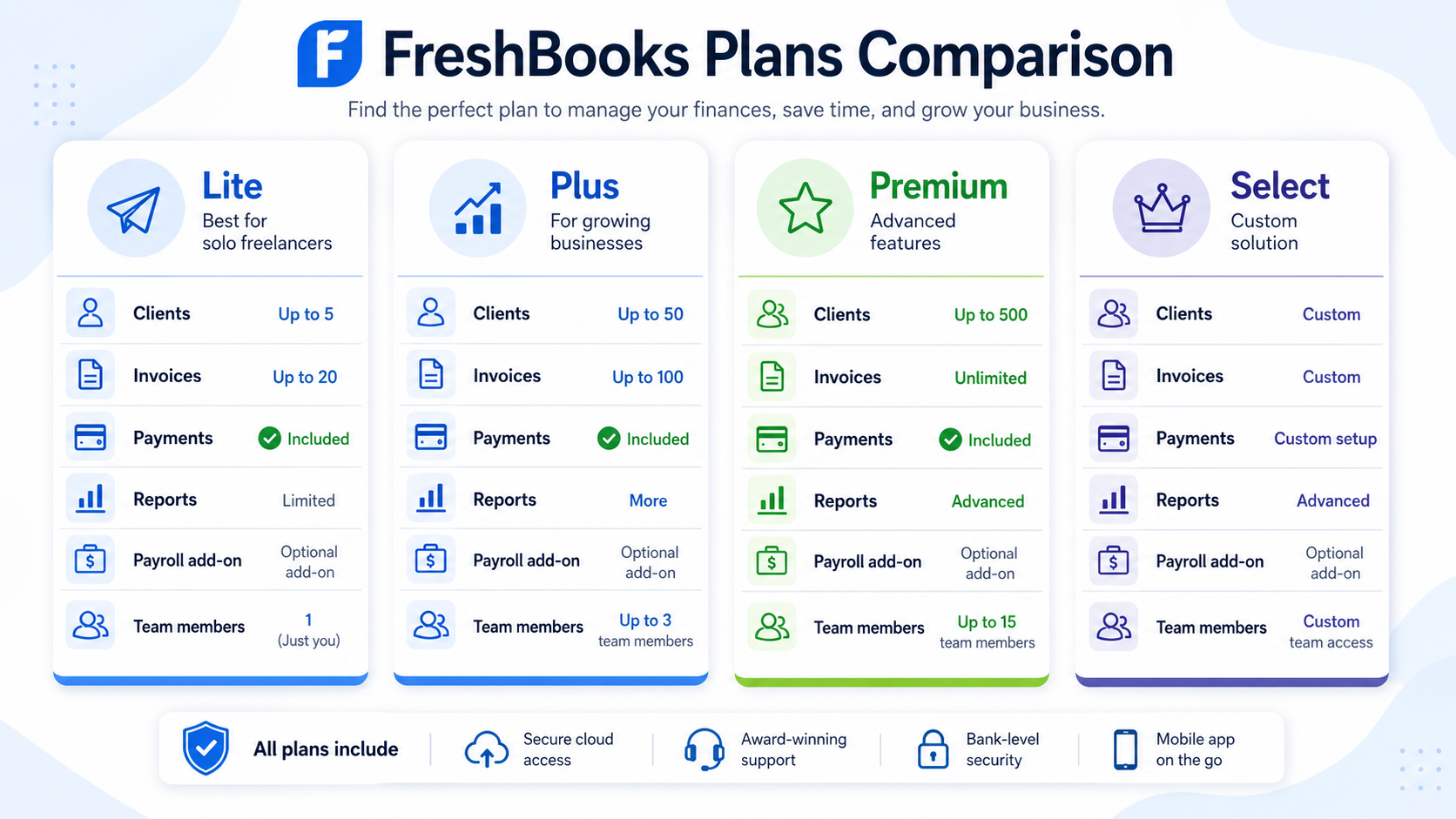
FreshBooks pricing changes from time to time, and promotional discounts can make prices look much lower during the first few months. For this fr</strong>eshbooks pricing review 2026, the most important point is to compare the regular price, not only the temporary discount.
FreshBooks generally offers Lite, Plus, Premium, and Select plans. Lite is best for a small number of clients. Plus suits growing freelancers and small businesses. Premium works better for unlimited clients and more advanced needs. Select is designed for larger businesses that want custom support, lower transaction rates, and onboarding help.
The hidden cost to watch is add-ons. Team members, Advanced Payments, and Payroll can increase your monthly cost. That is why FreshBooks is often best for solo owners or small teams, while larger teams should compare total cost carefully.
Pros & Cons
FreshBooks has many advantages, especially for users who want simple invoicing and beginner-friendly accounting. The biggest pros are easy setup, clean design, professional invoices, strong time tracking, useful expense tools, mobile access, payment links, recurring invoices, and helpful client management.
The biggest cons are plan limits, extra cost for additional users, limited advanced accounting compared with QuickBooks or Xero, payroll availability limits, and fewer advanced inventory features. These points matter if your business is growing fast or already has complex accounting needs.
This freshbooks pros and cons 2026 summary shows that FreshBooks is excellent for service businesses but not always ideal for product-heavy businesses, large teams, or companies that need advanced bookkeeping workflows.
Why Trust Our Software Reviews
TopPickr reviews focus on practical buying decisions, not hype. We look at what a tool does, who it helps, what it costs, where it saves time, and where users may feel limited after signing up.
ss=”isSelectedEnd”>For this FreshBooks review 2026, we considered official pricing pages, feature documentation, support details, public customer-review patterns, competitor comparisons, and common use cases for freelancers and small businesses. We also looked at how FreshBooks compares with tools like QuickBooks, Xero, Wave, Zoho Books, Invoice Ninja, Bonsai, HoneyBook, and Sage.
Our goal is simple: help readers choose the right software faster.
How We Test & Score Our Tools
TopPickr uses a weighted scoring method to compare software in a fair and consistent way. For this review, FreshBooks performs strongly in invoicing, ease of use, time tracking, mobile access, and beginner bookkeeping.
The final score depends on seven categories: core functionality, standout features, ease of use, onboarding, customer support, customer reviews, and value for money.
Core Functionality (25% of final score)
FreshBooks scores well in core functionality because it covers the essential needs of freelancers and small businesses. Users can create invoices, track expenses, manage clients, accept payments, track time, create estimates, send proposals, and view basic reports.
For service businesses, this core feature set is usually enough to manage daily operations. For larger companies, the functionality may feel less complete than QuickBooks or Xero.
Standout Features (25% of final score)
FreshBooks stands out because of its smooth invoicing workflow, time tracking, client portal, recurring billing, payment options, and beginner-friendly design. It also offers useful add-ons such as payroll and advanced payments.
The standout feature is not one single tool. It is the way FreshBooks combines invoicing, time, expenses, payments, and reports into a simple daily workflow.
Ease of Use (10% of final score)
FreshBooks is one of the easier accounting tools for non-accountants. Most users can create their first invoice quickly, add clients without confusion, and understand the dashboard without reading a long manual.
This is why freshbooks accounting software for beginners remains a strong search topic. FreshBooks reduces friction for users who want accounting software without feeling lost.
Onboarding (10% of final score)
FreshBooks offers a smoother onboarding experience than many traditional accounting tools. Users can start with basic company information, add clients, customize invoices, connect payments, and begin tracking expenses.
Select users may receive more personalized onboarding, but even regular users can get started quickly. That makes FreshBooks attractive for self-employed users who need speed.
Customer Support (10% of final score)
FreshBooks support is a strong point compared with many budget tools. The help center, chatbot, support articles, and available office-hour support give users several ways to solve problems.
Support quality can still vary by case, but FreshBooks generally feels more supportive than free or low-cost invoicing-only software.
Customer Reviews (10% of final score)
Customer reviews commonly praise FreshBooks for ease of use, invoicing, time savings, and small business friendliness. Many users like how quickly they can create invoices and manage basic finances.
Negative reviews often mention pricing, add-on costs, limited advanced features, or mobile app preferences. That feedback is important because FreshBooks is simple by design, and simple tools can feel limiting as a business becomes more complex.
Value for Money (10% of final score)
FreshBooks offers strong value for freelancers and small service businesses that need invoicing, payments, time tracking, expenses, and reports in one place. The value is highest when one owner or a small team uses it daily.
The value drops if you need many users, advanced accounting, complex inventory, or global payroll. In those cases, compare alternatives before committing.
Core Features
FreshBooks core features are designed around getting paid, staying organized, and reducing admin work. The most important tools include invoices, estimates, proposals, expenses, bank imports, time tracking, project tracking, payments, reports, accountant access, mileage tracking, and mobile apps.
For beginners, the most helpful feature is the clean invoice-to-payment workflow. You create an invoice, send it, let the client pay online, and track the payment. That simple process can improve cash flow and reduce manual work.
For service businesses, the most helpful feature is time tracking. You can track billable time and turn it into revenue instead of losing hours in spreadsheets.
Automated Payroll Runs
FreshBooks Payroll is available as a paid add-on powered by Gusto for eligible U.S. businesses. It can help businesses run payroll for employees and contractor payments from inside FreshBooks.
This section matters because some readers search for accounting and payroll in one platform. FreshBooks can support payroll, but it is not a universal global payroll system. Businesses outside the United States or businesses with complex payroll requirements should verify eligibility before buying.
Tax Filing and Remittance
FreshBooks Payroll can help eligible U.S. businesses with payroll tax filing and remittance through Gusto-powered payroll features. This can reduce manual payroll tax work for small employers.
However, payroll tax rules are sensitive. Business owners should confirm state registration, employee eligibility, and tax requirements before depending on any payroll platform.
Direct Deposit Payments
FreshBooks Payroll supports direct deposit for eligible payroll users. This helps businesses pay employees without printing checks or handling manual transfers.
Direct deposit is especially useful for small teams that want a professional payroll process. Still, payment timing and eligibility can vary, so users should review FreshBooks Payroll terms before setup.
Employee Self-Service Portal
Through payroll onboarding and employee management workflows, employees may be able to access payroll-related information depending on the FreshBooks Payroll and Gusto setup. This can reduce back-and-forth questions about payroll documents and payment details.
For small businesses, employee self-service can save time. For larger teams, compare Gusto directly, QuickBooks Payroll, and other payroll platforms before deciding.
Time Tracking Integration
FreshBooks connects time tracking with invoicing, which is one of its strongest features. Users can track billable hours, assign time to clients or projects, and add that time to invoices.
This is why freshbooks review for consultants, freshbooks review for contractors, and freshbooks review for agencies are important. These users often sell hours or project-based work, so time tracking directly affects revenue.
Ease of Use
FreshBooks is built for users who want to manage business finances without becoming accounting experts. The dashboard is simple, the invoice builder is clear, and the main features are easy to find.
This makes freshbooks bookkeeping review for beginners highly positive. A beginner can send invoices, track expenses, and review basic reports without feeling overwhelmed.
Integrations
FreshBooks integrates with payment processors, payroll tools, e-commerce tools, CRM tools, productivity apps, and reporting workflows. It may not have the deepest integration marketplace compared with QuickBooks or Xero, but it covers many common small business needs.
For online businesses, integrations can matter as much as pricing. That is why freshbooks review for online business should consider payment tools, bank connections, client workflows, and reporting needs before choosing a plan.
FreshBooks for Different Business Types
FreshBooks is especially strong for solo and service-based users. A <strong>freshbooks review for freelancers 2026 is positive because freelancers need fast invoices, simple expense tracking, and easy time billing.
s=”isSelectedEnd”>A <strong>freshbooks review for small business 2026 is also positive when the business sells services and has simple bookkeeping needs. However, product-based businesses with inventory may need stronger accounting software.
For self-employed professionals, this freshbooks review for self employed is practical because FreshBooks reduces manual admin work. For consultants, this freshbooks alternative for consultants comparison matters only if they need contracts, CRM, or deeper project tools.
For agencies, a freshbooks review for agencies is mixed. Small agencies may love the invoicing and time tracking. Larger agencies may want stronger project management, user permissions, and reporting.
For startups, this freshbooks review for startups depends on the business model. Service startups may benefit quickly. SaaS or inventory-heavy startups may need other systems.
For service providers, this freshbooks review for service business is very strong because FreshBooks matches the way service businesses bill clients.
FreshBooks vs QuickBooks 2026
The freshbooks vs quickbooks 2026 comparison depends on complexity. FreshBooks is easier for freelancers and service businesses. QuickBooks is stronger for advanced accounting, deeper reports, inventory, payroll options, accountant workflows, and growing companies.
For solo professionals, freshbooks vs quickbooks for freelancers often favors FreshBooks because it feels simpler and faster. For larger businesses, QuickBooks may offer more depth.
Choose FreshBooks if you want clean invoicing and simple accounting. Choose QuickBooks if you need more advanced bookkeeping power.
FreshBooks vs Xero 2026
The freshbooks vs xero 2026 comparison is closer for small businesses. Xero is powerful, scalable, and accountant-friendly. FreshBooks is easier for invoicing, time tracking, and service-based workflows.
For growing businesses, freshbooks vs xero for small business often depends on reporting and accounting needs. Xero may suit businesses with more complex bookkeeping. FreshBooks may suit owners who want less complexity.
FreshBooks vs Wave Accounting
The freshbooks vs wave accounting comparison usually comes down to budget. Wave has a free starter option for basic invoicing and bookkeeping, while FreshBooks charges a subscription but offers a more polished workflow for many service businesses.
Choose Wave if you need a free accounting tool. Choose FreshBooks if you want stronger invoicing, support, and service-business workflow.
FreshBooks vs Zoho Books
The freshbooks vs zoho books comparison is important for price-sensitive users. Zoho Books offers a broad feature set and a free plan in eligible cases, while FreshBooks focuses more on ease of use and service-business billing.
Zoho Books may be better for users who want more features at a lower cost. FreshBooks may be better for users who want a cleaner, simpler experience.
FreshBooks vs Invoice Ninja
The freshbooks vs invoice ninja comparison matters for users who mainly need invoicing. Invoice Ninja offers a strong free plan and low-cost invoicing features, including client portals and recurring invoices.
FreshBooks is better if you want invoicing plus simple accounting in a beginner-friendly interface. Invoice Ninja is better if you want a cheaper invoicing-first tool.
FreshBooks vs Bonsai
The freshbooks vs bonsai comparison is useful for freelancers who need contracts, proposals, client management, and project workflows. Bonsai is built around freelancer business management, while FreshBooks is stronger as accounting and invoicing software.
Choose Bonsai if contracts and proposals matter most. Choose FreshBooks if accounting, expenses, payments, and reports matter more.
FreshBooks vs HoneyBook
The freshbooks vs honeybook comparison is important for creatives and service providers. HoneyBook focuses on clientflow management, proposals, contracts, scheduling, payments, automation, and CRM-style workflows.
FreshBooks is better for accounting-first users. HoneyBook is better for client journey management, especially photographers, event businesses, designers, and consultants.
FreshBooks vs Sage Accounting
The freshbooks vs sage accounting comparison depends on business maturity. Sage is often stronger for more formal accounting, payroll, compliance, and established businesses. FreshBooks is easier for freelancers and service businesses that want fast invoicing.
Choose Sage if you need deeper accounting structure. Choose FreshBooks if you want speed and simplicity.
Alternatives to FreshBooks
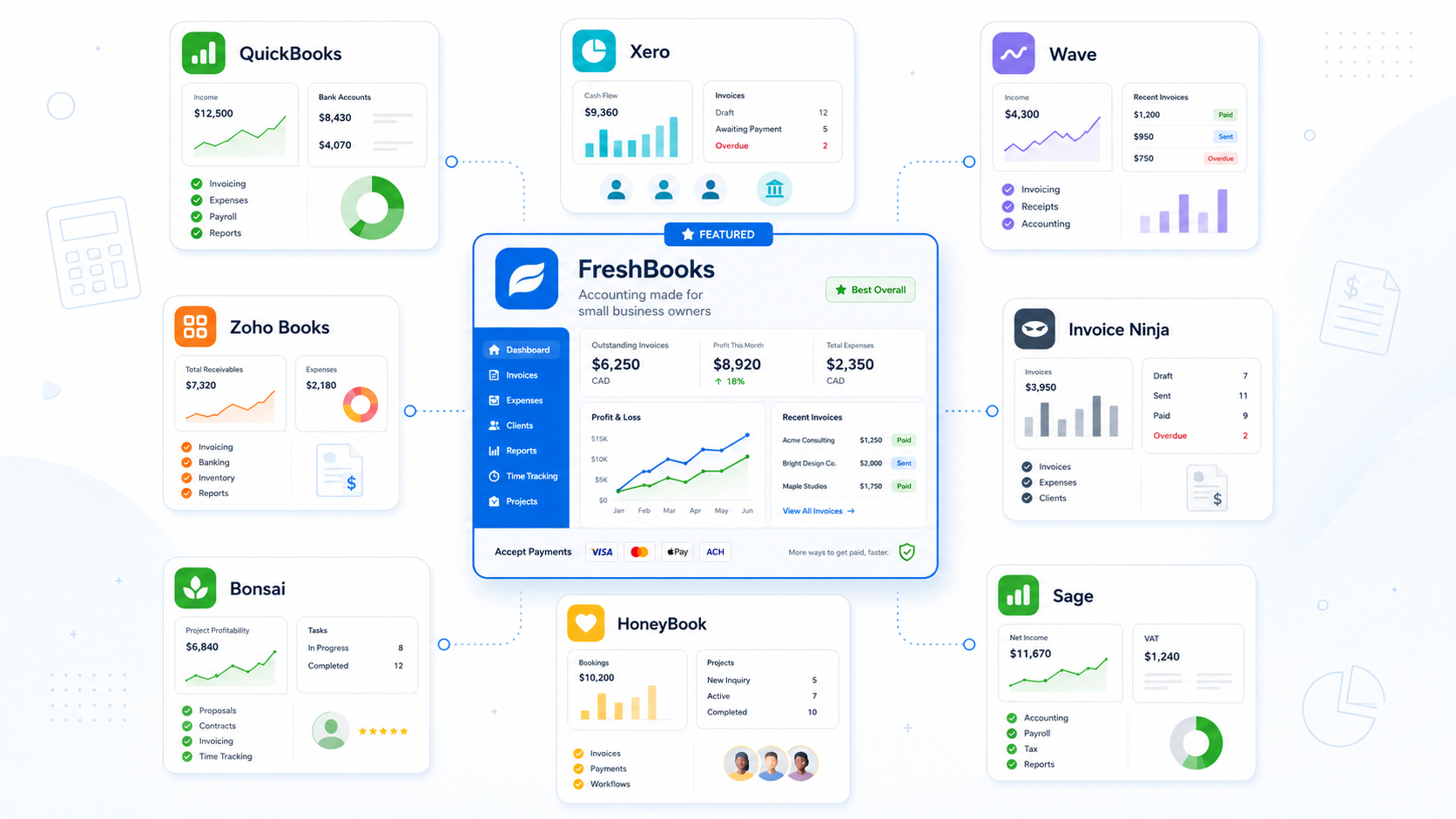
FreshBooks isn’t the only good option in 2026. Here are the top freshbooks alternatives for 2026: Quickbooks, Xero, Wave, Zoho Books, Invoice Ninja, Bonsai, Honeybook, Sage.
If you are looking for free FreshBooks alternatives, check out Wave, Zoho Books and Invoice Ninja. Invoice Ninja and Zoho Books are attractive for users seeking cheap freshbooks alternatives. If users are looking for Freshbooks alternatives with free plan then Wave, Zoho Books and Invoice Ninja should be in the shortlist.
For freelancers, the top freshbooks alternatives for freelancers include Bonsai, Invoice Ninja, Wave, and Zoho Books. Best Freshbooks Alternatives for Small Businesses QuickBooks Xero Zoho Books Sage Small Businesses
If you’re more interested in invoicing, freshbooks review 2026 include Invoice Ninja, Wave, Zoho Books and HoneyBook. Alternatives to Freshbooks for bookkeeping include Quickbooks, Xero, Zoho Books, and Sage. Online payments: A newbooks alternative may be Wave, QuickBooks, HoneyBook, or Stripe-connected invoicing software.
If you are looking for a freshbooks alternative no monthly fee, take a look at the free plans from Wave, Zoho Books or Invoice Ninja. But read limitations carefully. Looking for a Freshbooks alternative for contractors? Compare FreshBooks with QuickBooks, Xero and Bonsai. If you want to read a freshbooks review 2026 see how FreshBooks compares with HoneyBook, Bonsai, Xero and QuickBooks.
The bigger list of freshbooks review 2026 shows that FreshBooks is great but not necessarily the best fit for everyone.
Best Accounting Software Like FreshBooks
The best accounting software like freshbooks should include simple invoicing, expense tracking, payment options, reporting, client management, and mobile access. QuickBooks is best for deeper accounting. Xero is best for scalable bookkeeping. Wave is best for free basic accounting. Zoho Books is best for value. Invoice Ninja is best for low-cost invoicing. HoneyBook is best for clientflow. Bonsai is best for freelancer contracts. Sage is best for more formal accounting needs.
FreshBooks still wins when ease of use and service invoicing matter most.
Is FreshBooks Good for Freelancers?
Yes, is freshbooks good for freelancers is one of the easiest questions to answer. FreshBooks is very good for freelancers who send invoices, track billable hours, record expenses, and accept payments online.
Freelancers usually do not need complex accounting software at the beginning. They need to get paid, stay organized, and prepare for tax season. FreshBooks handles those jobs well.
Is FreshBooks Worth It 2026?
FreshBooks is worth it in 2026 if you value ease of use, professional invoicing, time tracking, expense tracking, online payments, mobile access, and simple reports. It is especially worth it for freelancers, consultants, contractors, self-employed professionals, and small service businesses.
FreshBooks may not be worth it if you need free software, advanced inventory, complex accounting, many users, global payroll, or deep customization. In those cases, compare FreshBooks alternatives before subscribing.
FreshBooks Review and Best Alternatives
This freshbooks review 2026 and best alternatives section gives the practical answer. FreshBooks is one of the best tools for simple invoicing and service-business accounting, but alternatives may beat it in specific areas.
Choose FreshBooks for ease of use. Choose QuickBooks for advanced accounting. Choose Xero for scalable bookkeeping. Choose Wave for free basic tools. Choose Zoho Books for value. Choose Invoice Ninja for cheap invoicing. Choose Bonsai for freelancer contracts. Choose HoneyBook for client workflows. Choose Sage for structured accounting and payroll needs.
The Bottom Line
FreshBooks is still one of the top accounting tools for freelancers and small service businesses in 2026. It simplifies invoicing, helps you track time and expenses, facilitates online payments, and provides a cleaner accounting experience for beginners than many traditional platforms.
Its best users are freelancers, consultants, contractors, self-employed professionals, small agencies and service businesses who want to save time and appear professional. The least appropriate size is a large company with complex accounting , inventory , payroll or multi-user needs .
Final verdict: If you want simple accounting software that will help you invoice faster, track money clearly and manage clients without frustration, then it’s worth looking at FreshBooks. Before you make a purchase, take a look at the current FreshBooks price versus QuickBooks, Xero, Wave, Zoho Books, Invoice Ninja, Bonsai, HoneyBook, and Sage to see which one best suits your budget and workflow.
or accurate pricing and feature verification, review the official FreshBooks pricing page: https://www.freshbooks.com/pricing