
Introduction
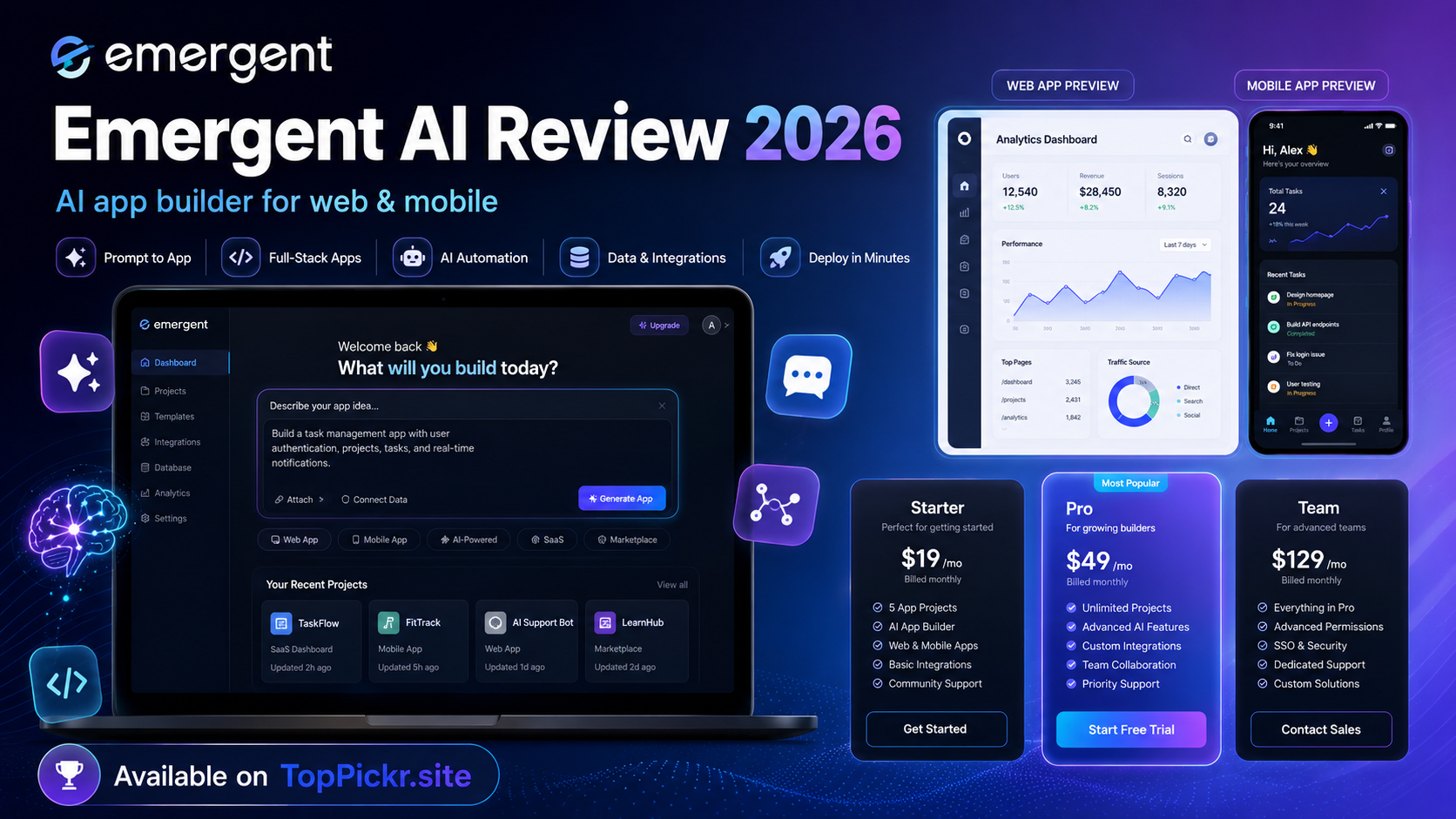
Imagine going from a simple app idea to a working product without hiring a developer, learning to code or spending months stuck in planning. That’s the big promise behind this emergent ai review 2026 and it’s exactly why so many founders, students, agencies and small business owners are looking for a real answer before they spend money.
The hard truth is: AI app builders are exciting, but they are not magic. Emergent AI can help users create websites, dashboards, web apps and mobile-style experiences from natural language prompts. But like any rapid AI development platform, it has limitations, credit costs, learning curves and real user complaints that buyers should first be aware of.
That’s why this review of an emerging AI app builder on TopPickr is focused on practical decision making, not hype. These Review are available on TopPickr for readers who want clear software comparisons before they decide on a paid plan. We will be looking at features, pricing, ease of use, app deployment, security, customer support, alternatives and the big question is emergent ai worth it in 2026?
By the end of this book, you’ll know whether Emergent is a smart shortcut or a tool you need to test carefully before you upgrade. This emergent ai honest review is for beginners, non-coders, developers, startups and small businesses who want to build faster without wasting credits or money.
For more AI and website-building comparisons, you can also read TopPickr’s related guides: Hostinger Horizons Review, Hostinger vs Namecheap Review, and Claude AI Review 2026.
What is Emergent Ai?
Emergent AI is an AI powered app builder that lets users describe in plain English what they want and build the software. Instead of beginning with code, hosting setup, database planning, authentication and UI design, you start with a prompt. AI agents then plan, generate, test and deploy parts of your application to the platform.
Emergent is a text to app builder, in simple terms. You tell the system what you want to build. For example, “Build a booking app for a salon with customer login, service categories, admin dashboard and payment tracking.” The system will try to create a working structure for the app.
This makes the tool appealing to people looking for an emergent ai review for beginners.” But many beginners want to build apps and they don’t know React, APIs, databases, backend logic, GitHub, deployment, or security. Emergent efforts to bridge that technical gap.
Emergent isn’t just a simple drag and drop builder though. Traditional no-code platforms often ask users to visually place the elements and manually set up the workflows. Emergent is more about “vibe coding” where the user describes the desired outcome and the AI handles the technical execution.
That’s why many people refer to it as an emergent ai app development tool and not just a website builder. It can be used for websites, dashboards, internal tools, SaaS MVPs, mobile app concepts, workflow apps, business automation tools.
For official details, readers can visit the Emergent AI website and compare its claims with real user feedback before subscribing.
Key Features
The biggest reason people search for an emergent ai features review is simple: they want to know what the tool actually does. Emergent offers several features that make it useful for fast prototyping and early product development.
AI App Generation from Prompts
The core feature is prompt-based app creation. Users can describe an idea, and Emergent attempts to create pages, logic, backend structure, database connections, and interface elements. This is the feature behind searches like emergent ai build app from prompt and emergent ai text to app builder.
Full-Stack Web App Building
The platform is useful for users searching for an emergent ai web app builder review. It does not only create static landing pages. It can help generate functional web apps with dashboards, forms, user flows, and backend logic.
Website Building
The platform can also work as an AI website builder for users who need simple web pages quickly. This makes it relevant for the keyword emergent ai website builder review, especially for business owners who need landing pages, portfolios, service pages, or MVP websites.
Mobile App Support
Emergent also promotes web and mobile app experiences. That makes it useful for anyone searching for an emergent ai mobile app builder review, although users should still check whether the final output meets their exact app store, device, and performance requirements.
AI Agents
A major part of the platform is its AI agent workflow. In this emergent ai ai agents review, the important point is that agents can help with planning, coding, testing, and iteration. The experience feels more like working with a junior technical team than using a traditional template builder.
Code Generation
Emergent can generate real application code, which matters for users who want ownership and flexibility. This makes the platform relevant for an emergent ai code generation review, especially when compared with tools that lock users inside proprietary systems.
GitHub and Deployment Support
Paid users may get stronger access to GitHub integration, private project hosting, and deployment support. That is why many people search for an emergent ai deployment review before upgrading.
Dashboard and Project Management
The dashboard gives users a central place to manage prompts, app previews, tasks, and builds. This section matters for anyone searching for an emergent ai dashboard review, because a clean interface can save time while a confusing one can waste credits.
Prices & Plans – 2026
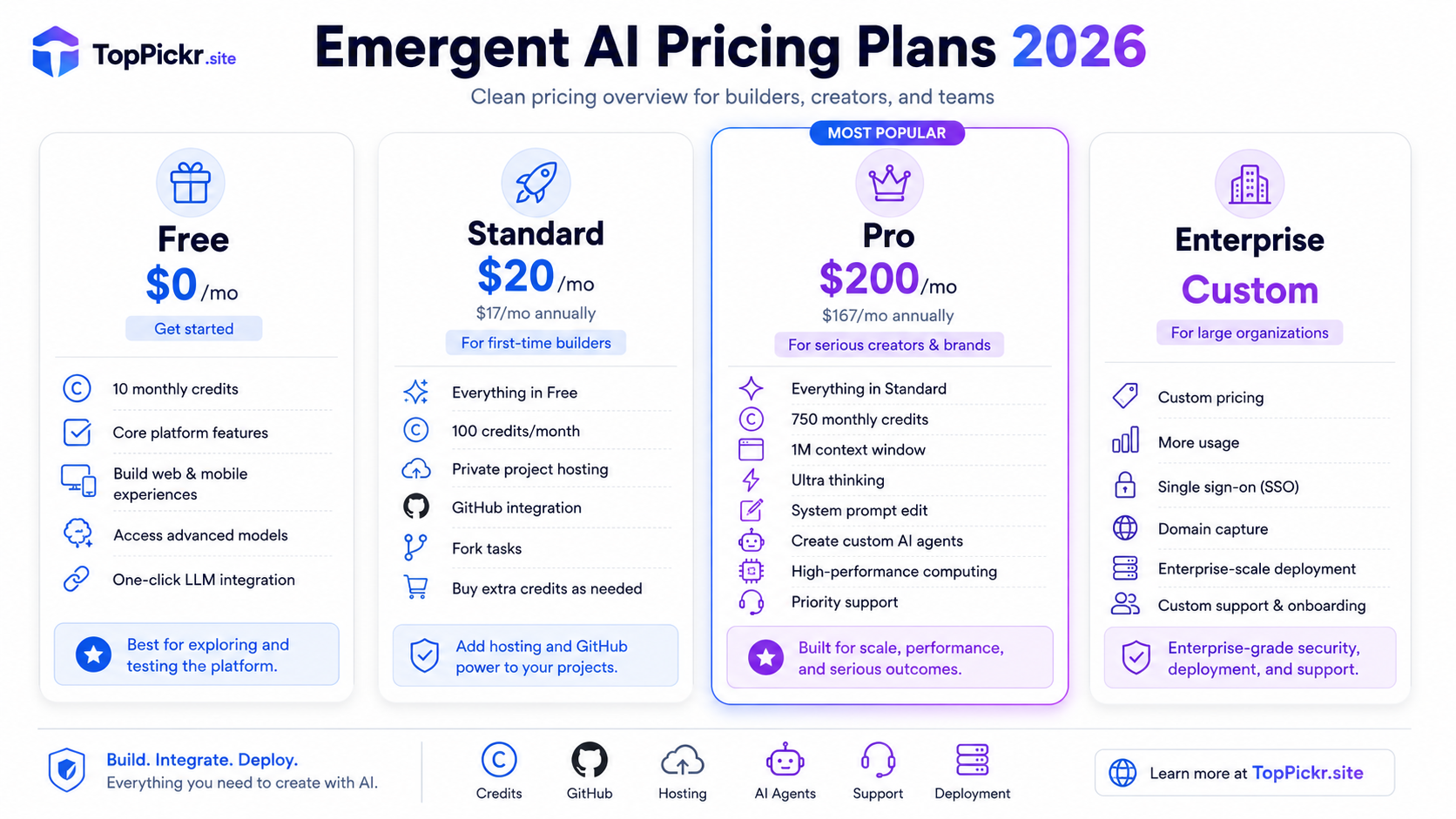
Pricing is one of the most important parts of this emergent ai pricing review because AI app builders often look cheap until credits start disappearing. Emergent uses a credit-based pricing model, which means your usage depends not only on the monthly fee but also on how many tasks, generations, fixes, and iterations your project needs.
Free Plan
The Free plan is useful for testing the platform before committing. This emergent ai free plan review finds that the free tier is best for exploring the interface, trying one small idea, and understanding how credits work. It is not ideal for building a serious production app because limited credits can run out quickly.
Standard Plan
The Standard plan is better for first-time builders who want more monthly credits and practical project features. It is usually the first paid option to consider if you want GitHub integration, private hosting, and more room to build.
Pro Plan
The Pro plan is designed for serious creators, brands, and users who need more credits and advanced AI capabilities. It can make sense for agencies, technical founders, or teams that build frequently. However, casual users should avoid upgrading before testing how many credits their project consumes.
Enterprise Plan
The Enterprise plan targets larger teams with custom needs. It is more relevant for companies that need SSO, compliance support, audit logs, role-based access, and larger usage limits.
Pricing Verdict
The best approach is to test first, then upgrade only when your app idea is clear. Credit-based tools reward focused prompts and punish vague experimentation. If you start with unclear instructions, you may spend credits on repeated fixes instead of progress.
Pros & Cons
Every emergent ai full review must include both strengths and weaknesses because the tool is powerful but not perfect. Here is a practical look at the emergent ai pros and cons.
Pros
The first major benefit is speed. Emergent can help users move from idea to working prototype much faster than traditional development.
The second benefit is beginner access. Non-technical users can describe ideas in normal language instead of writing code.
The third benefit is full-stack ambition. Emergent is not limited to simple landing pages. It can help with app logic, dashboards, databases, and integrations.
The fourth benefit is code ownership. Users who care about portability may prefer a tool that can generate real code and connect with GitHub.
The fifth benefit is useful for business experiments. Startups can validate MVPs faster, and agencies can create quick client demos.
Cons
The biggest drawback is credit uncertainty. Users may not know exactly how many credits an app will need until they start building.
The second drawback is AI inconsistency. Like many AI coding tools, Emergent may occasionally create bugs, incomplete logic, or features that need manual review.
The third drawback is support expectations. Some users may expect human-level technical support for every issue, but AI app builders still require patience.
The fourth drawback is not every app should be built with AI alone. Complex fintech, healthcare, legal, enterprise, or security-heavy software still needs expert developer review.
The final drawback is beginner overconfidence. A tool can generate an app quickly, but users still need to test user flows, payments, authentication, database behavior, privacy, and deployment before going live.
What You Get with a Paid Plan
A paid plan mainly just gives you more space to build, improve and deploy. Free plans are great for testing, but when your project gets serious, you’ll most likely need paid plans.
Most paid plans offer more credits for app generation and iteration. This is important because building an app is rarely done in one prompt. You may need to improve pages, fix bugs, change layouts, add integrations, improve database logic, and test deployment.
Paid plans also unlock more powerful project hosting and GitHub workflows. Many founders are interested in the GitHub integration because it makes the code portable. That can be important if you later hire a developer or change the hosting situation for the app.
Advanced AI features could also be part of paid tiers. These include larger context windows, more powerful reasoning, custom AI agents, or priority support depending on the plan.
So the smart move is to upgrade only after you have a clear project brief. Define who are your target users of the app. What pages and database fields you need. Login & payment needs. Integrations. Must-have features. Before paying. It reduces waste in credits and improves output quality.
Ease of Use & User Experience
Emergent is easier than traditional coding, but certainly not easy. The platform does save people a lot of technical steps, but users still have to be able to explain their idea clearly.
The biggest plus for beginners is building conversation. You don’t need to know how to build routes, components, APIs, schemas, or deployment pipelines. You can ask the AI to build and tune features.
Non-coders should write very detailed prompts for the best experience. A weak prompt like “make me an ecommerce app” could produce a generic result. A more powerful prompt, such as, “create a small clothing store with customer login, product filters, cart, stripe checkout, admin inventory dashboard, and order status tracking,” gives the AI more guidance.
For developers the value is another. Emergent allows developers to create fast scaffolds, MVPs, dashboards or proof-of-concept apps. This makes emergent ai for developers more about speed than replacement of engineering skill.
Expectations are the user experience for small teams. If you’re looking for a slick SaaS product in one click, you may be disappointed. Treating Emergent as a fast AI development assistant makes the experience more realistic.
Getting Started
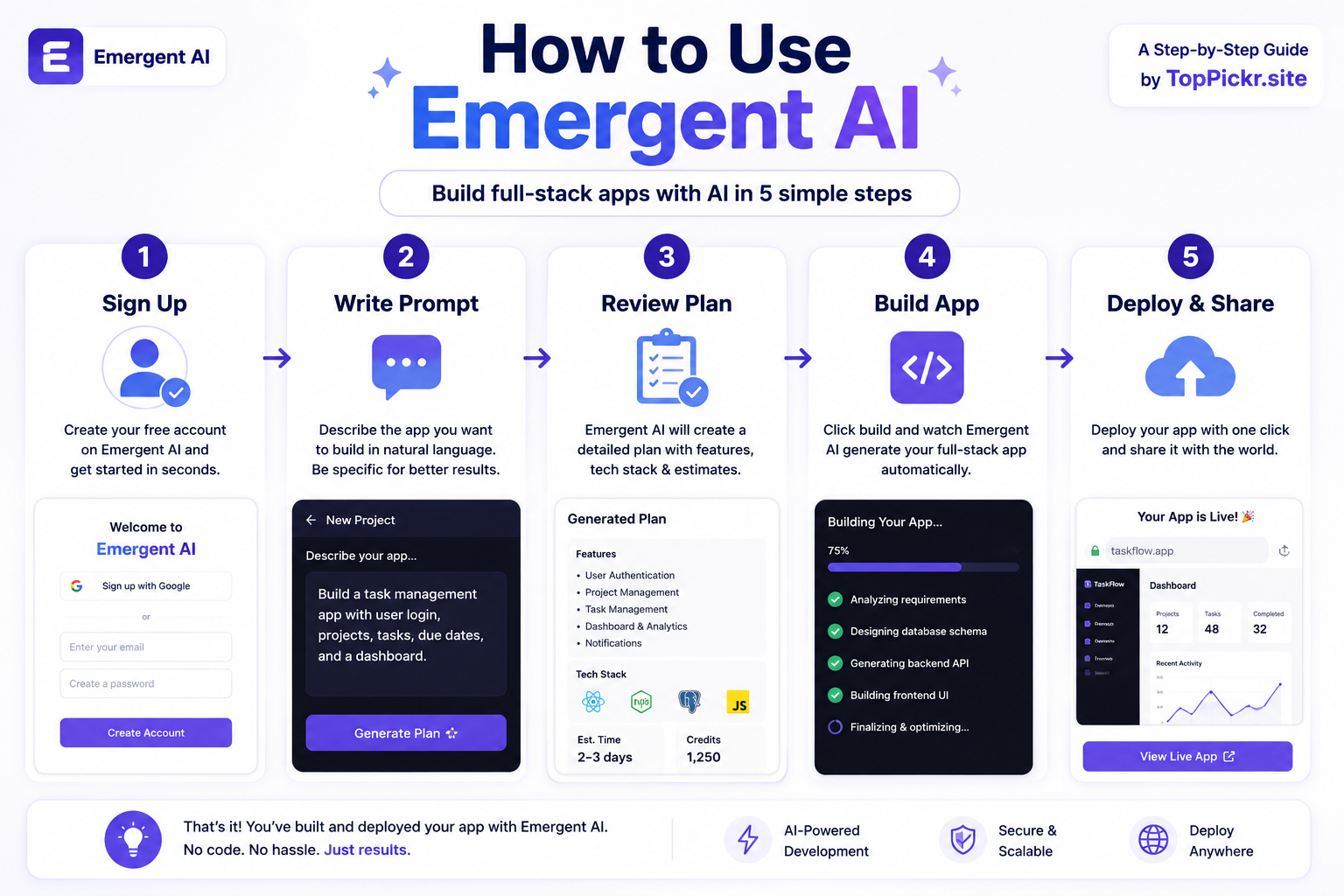
Getting started with Emergent is simple if you prepare your idea before logging in. This section works as an emergent ai beginner guide for first-time users.
Step 1: Create an Account
First, visit the official Emergent website and sign up with your email or available login option. This part belongs in any emergent ai login and setup guide because users should always start from the official website to avoid fake pages or misleading ads.
Step 2: Write a Clear App Prompt
Next, describe your app in detail. Include your app type, target users, pages, features, data fields, design style, integrations, and success goal.
Step 3: Review the Generated Plan
Then, check the app plan before letting the AI continue. If the structure looks wrong, correct it early. Early corrections save credits.
Step 4: Build in Small Stages
After that, build one major feature at a time. Start with login, then dashboard, then database, then payments, then deployment. This controlled workflow is the safest answer to how to use emergent ai without wasting credits.
Step 5: Test Everything
Finally, test every page and workflow before sharing the app with real users. AI-generated apps can look complete while still having hidden logic errors.
Emergent AI Tutorial for Beginners
A newb-friendly workflow can be the difference between a successful build and wasted credits. This is a beginner tutorial for emergent ai with a simple mvp method.
Begin with one simple use case. For example, instead of requesting a full marketplace, request a booking dashboard for one service business.
Then tell Emergent to build only the core pages. These could be: homepage, login, admin dashboard, user dashboard, booking form and confirmation page.
Then, ask for the structure of the database. Request tables like users, bookings, services, payments & messages.
Then test the app as a normal user would. Sign up, log in, create booking, edit booking, delete booking, see admin view.
Finally, improve the design and deployment only when the logic is working. Most beginners burn credits on colours and layouts before the app properly works.
Interface
The interface is one of the most important parts of an AI app builder because users need to understand what the AI is doing. Emergent’s interface is designed around conversation, previews, build tasks, and project progress.
A good interface should make prompt history easy to follow. When an AI changes code, users need to know what changed and why. This helps beginners stay confident and helps developers review the output.
The preview area matters because users need fast feedback. If a page breaks or a button does not work, users should notice it before spending more credits.
The dashboard also matters for project organization. If you build multiple apps, you need a clear way to separate projects, manage versions, and continue work without confusion.
Overall, the interface feels best when users work in small steps. Large, vague requests can make the process harder to track, while focused requests keep the workspace cleaner.
Customer Support
Customer support is a serious buying factor as AI-generated apps can break in confusing ways. When users want to know if real people are happy with their purchase, they look for emergent ai customer reviews.
The public review picture looks mixed. Some users like the speed, interface and ability to build apps quickly. Others complain of credit usage, slow responses, glitches or problems getting the expected results. This is why any emerging ai trustpilot review should be taken in balance.
Most common emergent AI complaints tend to be credits, bug fixing, expectations, and support. But that doesn’t mean the tool is bad for all. This means that users should do careful testing before relying on it for mission-critical projects.
The best way to protect yourself is to document every single issue, clearly. Take screenshots Save prompt history Report a bug Ask for one fix at a time. This eases support conversations and reduces repeated troubleshooting.
Best Alternative to Emergent.ai
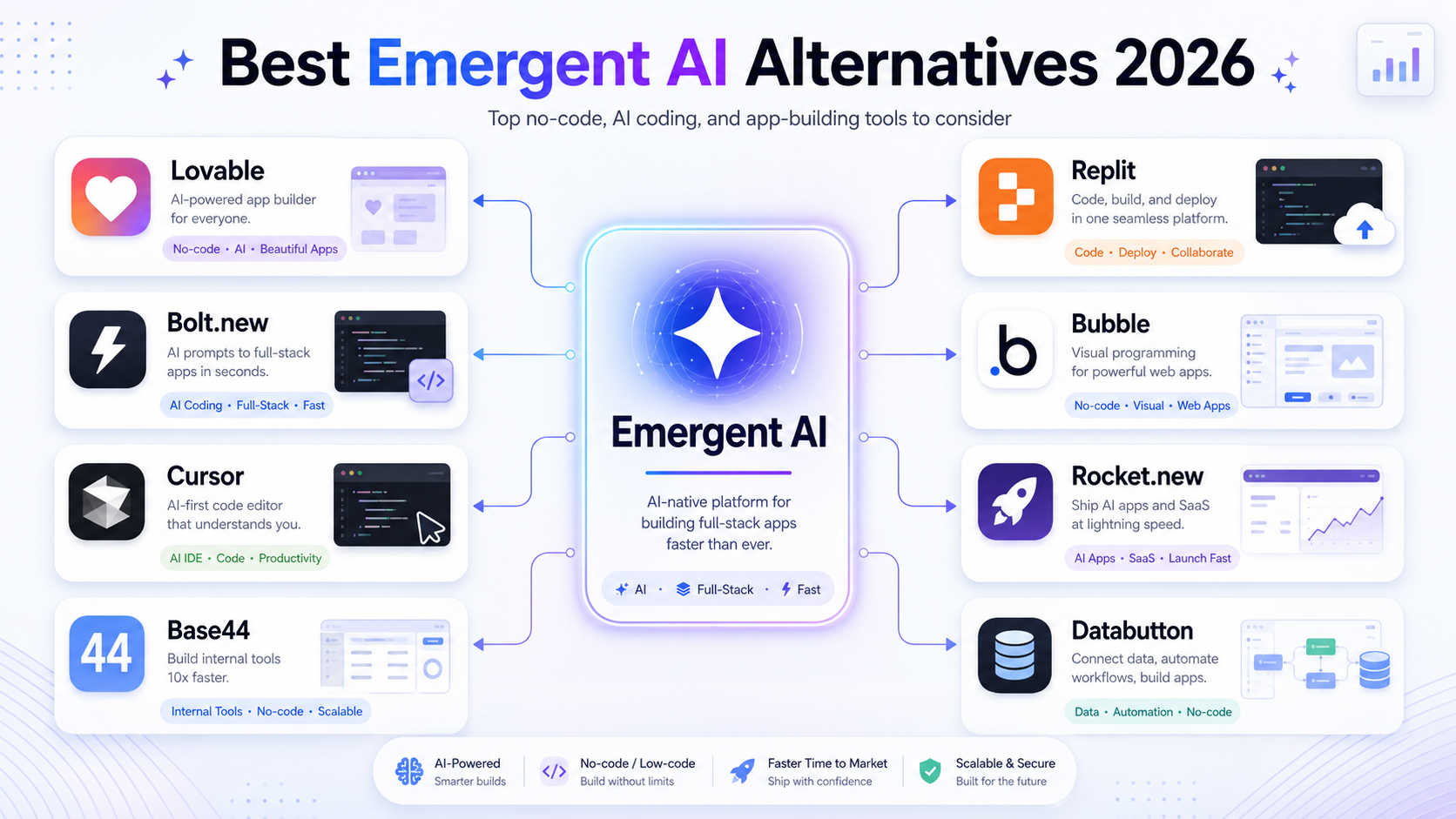
The best alternative depends on what you want to build. There is no single winner for every user, so this emergent ai alternatives section focuses on practical use cases.
Lovable
Lovable is a strong choice for founders who want polished web app prototypes and a friendly building experience. People searching for emergent ai vs lovable usually compare ease of use, design quality, Supabase workflows, and code ownership.
Bolt.new
Bolt.new is popular for fast browser-based app generation. Users comparing emergent ai vs bolt new often care about speed, front-end flexibility, and how quickly they can generate working prototypes.
Cursor
Cursor is better for developers who already understand code. In an emergent ai vs cursor comparison, Emergent is easier for non-coders, while Cursor gives developers more control inside a real coding environment.
Base44
Base44 is another AI app builder focused on turning ideas into functional products. In an emergent ai vs base44 comparison, users should compare pricing, app complexity, integrations, backend control, and export options.
Rocket.new
Rocket.new may appeal to users who want quick app interfaces and modern AI build workflows. For emergent ai vs rocket new, compare design quality, deployment options, mobile support, and pricing predictability.
Replit
Replit is useful for learners, developers, and technical founders who want AI help inside a coding workspace. In emergent ai vs replit, Emergent may feel easier for non-coders, while Replit may suit users who want to see and edit code more directly.
Bubble
Bubble remains powerful for visual no-code web apps. In emergent ai vs bubble, Bubble offers mature no-code workflows, while Emergent focuses more on prompt-based generation.
Traditional Coding
Traditional coding still wins when the project requires maximum control, security, scalability, and custom architecture. In emergent ai vs traditional coding, Emergent is faster for MVPs, but expert developers remain important for complex production systems.
For a broader comparison, readers can explore official sites like Lovable, Bolt.new, Cursor, Base44, Replit, and Bubble.
Best Emergent AI Alternatives 2026
The best emerging AI tools for 2026 are the ones that suit your skill level and project goal. For beginners, try Lovable, Base44, Bubble, and Emergent. Developers should give Cursor, Replit and Bolt.new a try. Specialised mobile app builders are also worth comparing if you are a mobile-first builder.
Emergent is worth trying if you want the fastest AI-generated MVP. Cursor or Replit might be better for more hands-on control. If you want visual no-code maturity, Bubble may be a safer bet. If beginner-friendly AI product builders are what you seek, then Lovable and Base44 are strong competitors.
For many readers, the best way is not to blindly choose one tool. Test the same app idea with two or three free plans. Compare credit usage, output quality, bugs, deployment and ease of editing. After an actual test the winner is obvious.
Who Should Use Emergent vs Databutton
Emergent and Databutton serve overlapping users, but they are not identical. This section helps readers understand who should use each one.
Emergent is better for users who want a conversational AI builder for full-stack apps, websites, dashboards, and mobile-style products. It suits non-coders, founders, agencies, and teams that want to move quickly from idea to prototype.
Databutton may appeal more to users who want AI-assisted app creation with a stronger focus on data apps, internal tools, and structured workflows. Readers can visit the Databutton website to compare its current plans and positioning.
Use Emergent if you want fast app generation from plain English prompts. Use Databutton if your app idea is more data-heavy and you prefer its workflow style.
For startups, Emergent can be useful when speed matters more than perfect architecture at the beginning. This makes emergent ai for startups a strong use case, especially for MVP testing.
For small companies, Emergent can help create internal tools, booking systems, dashboards, and simple business apps. That makes emergent ai for small business a practical keyword and use case.
For non-technical users, Emergent may feel more accessible than developer-first tools. This is why emergent ai for non coders is one of its most important audiences.
Emergent Ai Performance
Performance depends on the complexity of the app, the quality of prompts and the amount of testing the user does. Emergent can produce some pretty good first versions, but users should not assume every app generated is production ready without review.
Simple apps perform better than complex apps. It’s much easier for AI to build a landing page, appointment form or small dashboard than a complex marketplace with real-time chat, payments, advanced roles, and analytics.
Performance is also affected by prompt quality. Clear app requirements provide better structure. Generic pages, missing logic or repeated revisions are often the result of vague prompts.
Performance has a final filter – testing. Before going live, verify loading speed, login behaviour, form validation, mobile responsiveness, database updates, broken links, and error handling.
The practical verdict is simple: Emergent is best used by users building focused MVPs and improving step by step.
Emergent Ai Security
Security is essential as app builders often work with user data, logins, API keys and payment flows. Emergent includes enterprise-level security features, but larger teams should review its official security claims before using it for sensitive projects.
For ordinary users, the most important security habits are simple, but powerful. Do not include any private customer data in the prompt. Never hardcode secret API keys. Use strong passwords Authenticate reviews. Test roles permissions. Check that normal users cannot access admin pages.
Businesses must do a security review before launch. If your app handles payments, health, student, legal or private business records, have a security expert or a developer review it.
AI is a tool to build software faster. It will not replace security accountability. The user still needs to verify privacy, database rules, access control and compliance requirements.
Emergent Ai App Deployment
Deployment is where many AI app builders become either useful or frustrating. A prototype is exciting, but the real value comes when users can publish and share a working app.
Emergent aims to simplify deployment by helping users move from prompt to live product. This makes emergent ai deployment review an important topic for anyone building a public-facing app.
Before deployment, users should complete a final checklist. Test all pages. Check mobile layout. Confirm login and logout. Test forms. Review database changes. Check payment flows if used. Scan for placeholder text. Remove demo data. Confirm privacy policy and terms pages if needed.
After deployment, monitor real user behavior. Ask testers to report bugs. Track broken flows. Improve the app gradually instead of rebuilding everything at once.
The best deployment advice is to launch a small version first. Do not try to deploy a giant app in one attempt. Ship a simple MVP, collect feedback, and improve it.
How Many Credits Can an App Be Developed In?
Credit usage is the hardest question because every app is different. A simple landing page may require only a small number of credits, while a full SaaS app with login, dashboard, database, payments, and integrations may require many more.
The number of credits depends on app complexity. A basic website uses fewer credits. A dashboard uses more. A mobile app concept may use more. A complex app with backend logic, AI features, external APIs, and repeated bug fixes can consume credits quickly.
The number also depends on prompt quality. A clear prompt can reduce revisions. A vague prompt can create wrong features, which then requires more fixes.
The safest method is to create a credit budget before building. Decide what you want to achieve in the first 10, 50, or 100 credits. Build only the most important feature first.
Credit-Saving Prompt Example
Use this prompt style to reduce wasted credits: “Build only version one of a booking app. Include user signup, service list, booking form, admin booking table, and simple status updates. Do not add payments, chat, reviews, or advanced analytics yet.”
This focused approach helps users answer the question: emergent ai worth it? If the tool builds your core feature within a reasonable credit cost, it may be worth upgrading. If it burns credits without solving your core workflow, test alternatives.
Emergent AI Problems and Solutions
Most AI builder problems have practical solutions if users work carefully. This section covers emergent ai problems and solutions in a simple way.
Problem one is vague output. The solution is to write more specific prompts with user roles, pages, database fields, and design requirements.
Problem two is broken logic. The solution is to test one workflow at a time and ask the AI to fix the exact issue.
Problem three is fast credit usage. The solution is to plan before prompting and avoid asking for too many features at once.
Problem four is weak design. The solution is to provide a style direction, such as “clean SaaS dashboard, white background, blue accent color, sidebar navigation, mobile responsive layout.”
Problem five is deployment confusion. The solution is to deploy only after the core workflow works in preview.
Problem six is unrealistic expectations. The solution is to treat Emergent as an AI development assistant, not a guaranteed replacement for all developers.
Emergent AI Limitations
Every tool has limits, and understanding emergent ai limitations helps users avoid disappointment. Emergent can build quickly, but it may not always understand complex business rules on the first try.
Complex apps may need human review. If your project includes advanced permissions, payment edge cases, AI model integrations, sensitive data, or high traffic, involve a developer.
AI-generated code may contain bugs. Even when the app looks good, hidden issues can appear during real user testing.
Credit-based pricing can feel unpredictable. Users should watch usage carefully and avoid unlimited experimentation.
Design quality may need refinement. AI can generate layouts, but brand-level polish may still require design edits.
Support may not solve every issue instantly. Users should keep expectations realistic and document problems clearly.
Is Emergent AI the Best AI App Builder?
Emergent can be one of the better options for users who want fast app building through prompts. However, calling it the emergent ai best ai app builder depends on your needs.
It may be best for non-coders who want full-stack app generation. It may not be best for experienced developers who prefer complete control in an IDE. It may also not be best for visual builders who prefer manual drag-and-drop workflows.
The real question is not whether Emergent is best for everyone. The real question is whether it is best for your project, budget, and skill level.
If you need speed, prompt-based building, and a working MVP, Emergent is worth testing. If you need deep customization, strict compliance, and advanced engineering, use it with developer review.
Final Verdict on Emergent.ai: Is it Hard Trying?
The bottom line is that Emergent AI is worth a shot, but it’s not a tool you should buy blindly. Emergent ai review top pickr guide Emergent is a good choice for quick MVPs, small business tools, startup prototypes, dashboards and beginner-friendly app building.
The main reason to try it is speed. You can describe an idea and get a working structure faster than with traditional development. That makes it valuable for founders, agencies, students, creators and small businesses.
Your credit usage is the biggest reason to be cautious. If your prompt is unclear or your app is complex, credits can go faster than expected. That’s why users should start with the free plan, make a clear project brief, and test one feature at a time.
So is emergent ai worth it? Yes, it can be worth it for focused MVPs, prototypes, dashboards and simple business apps. No, it may not be worth it if you expect a production perfect app without testing, planning or technical review.
The best advice is simple: try Emergent with a small app idea first. Compare with Lovable, Bolt.new, Cursor, Base44, Replit, Bubble, Rocket.new, Databutton. Then, if the tool builds your core workflow at acceptable quality and credit usage, upgrade.
So what’s the answer for readers on TopPickr.site? Emergent AI is exciting, useful and worth testing in 2026, but smart users should treat it like a powerful AI assistant — not a guaranteed one-click software company.
FAQ
Is Emergent AI good for beginners?
Yes, Emergent AI can be good for beginners because it uses natural language prompts instead of traditional coding. However, beginners should learn how to write clear prompts and test each feature carefully.
Can Emergent AI build a full app from a prompt?
Yes, Emergent AI can help build apps from prompts, but results depend on complexity and prompt quality. Simple apps work better than large, advanced platforms.
Is Emergent AI no-code?
Yes, this emergent ai no code review finds that non-coders can use the platform without writing code. However, serious projects may still need developer review.
Is Emergent AI vibe coding?
Yes, this emergent ai vibe coding review shows that the platform fits the vibe coding trend because users describe outcomes and AI generates the app.
Can I use Emergent AI for business apps?
Yes, Emergent AI can be used for small business apps, internal tools, dashboards, booking systems, and MVPs. Businesses should still test security and workflows before launch.
What is the best alternative to Emergent AI?
The best alternative depends on your goal. Lovable is strong for polished MVPs, Cursor is strong for developers, Bubble is strong for visual no-code apps, Replit is useful for coding workflows, and Databutton may suit data-heavy apps.